
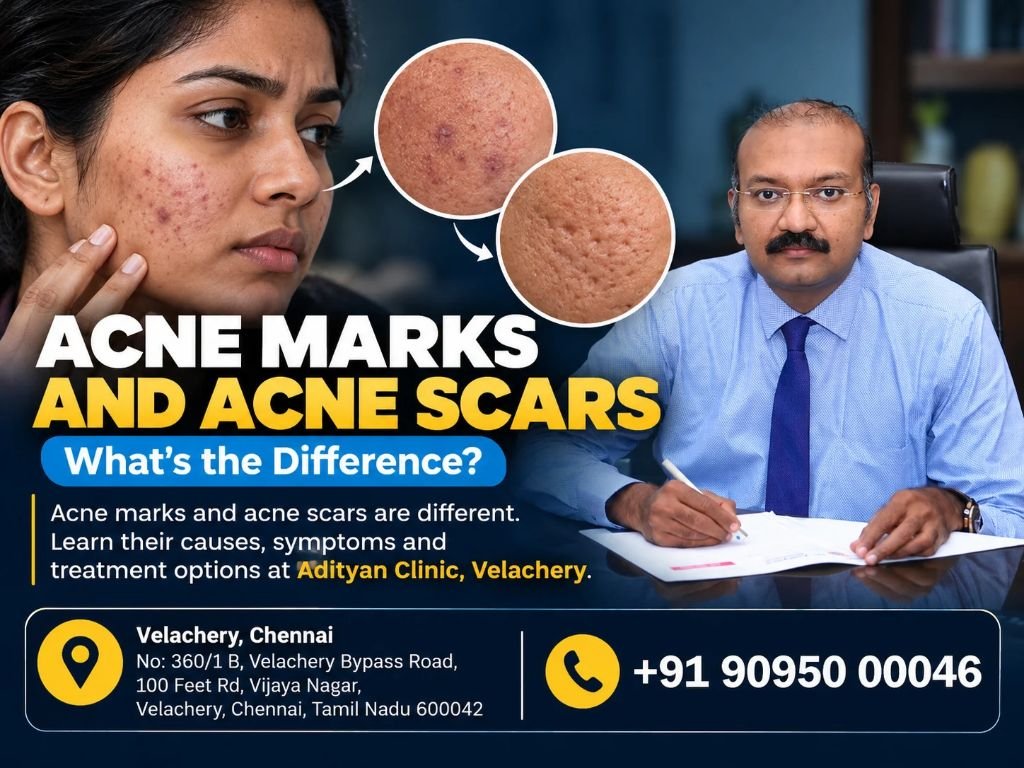
Acne Marks and Acne Scars: What Is the Difference and Can They Be Treated?
Acne marks and acne scars are two common skin concerns that can remain long after pimples have healed. Although people often use these terms interchangeably, they describe different changes in the skin. Acne marks usually involve changes in skin colour, while acne scars involve changes in skin texture caused by tissue damage. Understanding this difference is important because each condition responds to different treatments. At Adityan Hair and Skin Care Clinic in Velachery, Chennai, identifying the type of post-acne skin change helps determine suitable treatment options for improving skin appearance.
Acne can affect teenagers and adults, particularly those with oily skin, hormonal fluctuations or a family history of acne. Even after active breakouts settle, dark spots, redness or uneven skin texture may remain. These changes can affect confidence, but many can be managed with appropriate skincare and dermatological treatment.
What Is the Difference Between Acne Marks and Acne Scars?
The main difference lies in whether the skin's colour or structure has changed.
Acne marks are usually flat areas of discolouration that appear after inflammation. They may look brown, dark grey, red or pink, depending on the person's skin tone and the type of inflammation.
Acne scars develop when deeper inflammation damages the skin's supporting tissue. During healing, the body may produce too little or too much collagen, resulting in depressed or raised scars.
Marks often fade gradually, whereas established scars generally require procedures to achieve noticeable improvement.
Quick answer: Acne marks mainly affect skin colour, while acne scars affect skin texture. Flat marks may fade with time and suitable skincare, whereas depressed or raised scars often need targeted procedures for visible improvement.
Acne Marks and Acne Scars: Causes, Appearance and Symptoms
What Are Acne Marks?
Acne marks commonly develop after inflammatory pimples heal. The inflammation can stimulate excess melanin production, leaving darker areas known as post-inflammatory hyperpigmentation.
This is particularly common in Indian skin tones, where pigmentation may persist for several months.
Some people develop red or pink marks caused by lingering vascular changes, known as post-inflammatory erythema.
Unlike true scars, these marks generally do not create permanent indentations or raised areas.
Sun exposure, repeated breakouts and picking at pimples may worsen discolouration or delay fading.
What Are Acne Scars?
Acne scars form when inflammation damages deeper skin layers and interferes with normal tissue repair.
Atrophic scars appear as depressions because insufficient collagen is produced during healing. Common types include ice-pick scars, boxcar scars and rolling scars.
Ice-pick scars are narrow and deep, while boxcar scars have more defined edges. Rolling scars create broader, uneven depressions.
Raised scars occur when excess collagen develops. Hypertrophic scars remain within the original injury, while keloids may extend beyond it.
Different scar types often require different treatment approaches.
Acne Marks vs Acne Scars: Comparison Table
| Feature | Acne Marks | Acne Scars |
|---|---|---|
| Main problem | Skin discolouration | Change in skin texture |
| Appearance | Flat brown, grey, red or pink spots | Depressed or raised areas |
| Main cause | Inflammation affecting pigment or blood vessels | Damage to deeper skin tissue |
| Skin texture | Usually remains smooth | May become uneven |
| Natural fading | Often improves gradually | Usually persists without treatment |
| Common treatments | Sunscreen, topical medicines and selected procedures | Microneedling, laser, subcision and other procedures |
| Treatment duration | Depends on pigmentation and skin response | Often requires multiple sessions |
The appearance of a spot alone may not reveal whether it is pigmentation or a true scar. Some patients have both conditions in the same area.
Why Do Acne Marks Develop After Pimples?
When a pimple becomes inflamed, the skin releases chemical signals involved in healing. These signals can stimulate pigment-producing cells and lead to increased melanin production.
As the inflammation settles, the excess pigment may remain visible.
Darker skin tones are generally more prone to post-inflammatory hyperpigmentation.
Squeezing pimples, using irritating products and leaving active acne untreated can increase the likelihood of persistent marks.
Repeated sun exposure may also make existing pigmentation more noticeable.
Why Do Some Pimples Leave Permanent Scars?
Not every pimple causes scarring. Deep inflammatory acne, including nodules and cysts, is more likely to damage surrounding tissue.
When inflammation extends into the dermis, normal collagen structures may break down.
During healing, insufficient collagen can produce depressed scars, while excessive collagen can create raised scars.
Genetic factors, acne severity and delays in controlling inflammation may influence scar development.
Picking or squeezing inflamed lesions can increase tissue injury and the risk of scarring.
Treatment Options for Post-Acne Marks and Scarring
Can Acne Marks Fade Naturally?
Many flat post-acne marks gradually become less noticeable as the skin renews itself.
However, fading may take several months, and some pigmentation can persist considerably longer.
The duration depends on skin tone, inflammation severity, sun exposure and whether new breakouts continue.
Daily sun protection and suitable skincare can support gradual improvement.
Persistent pigmentation may respond to dermatologist-recommended ingredients such as azelaic acid, retinoids or other targeted treatments.
The choice of product should consider skin sensitivity, acne activity and pigmentation severity.
Can Acne Scars Be Removed Completely?
Acne scar treatment aims to improve texture and reduce the visibility of scars rather than guarantee complete removal.
Treatment results depend on scar depth, type, location and individual healing response.
Shallow scars may respond differently from deep ice-pick scars or tethered rolling scars.
Several procedures may be combined when multiple scar types are present.
Improvement is often gradual because collagen remodelling takes time, and multiple treatment sessions may be necessary.
Treatment Options for Acne Marks
Topical Treatments and Pigmentation Care
Topical skincare is commonly used for flat pigmentation.
Depending on the skin condition, dermatologists may recommend retinoids, azelaic acid or other pigment-targeting ingredients.
Sunscreen is particularly important because ultraviolet exposure can darken existing marks.
Chemical peels may be considered for selected patients, but treatment strength must be appropriate for the skin type.
Overly aggressive procedures can worsen pigmentation, especially in darker skin tones.
Treatment Options for Acne Scars
Microneedling, Laser and Subcision
Microneedling creates controlled micro-injuries that stimulate collagen remodelling and may improve certain depressed scars.
Fractional laser treatments can also improve selected scar types by encouraging skin resurfacing and collagen production.
Subcision is commonly considered for rolling scars attached to deeper tissue. It releases fibrous bands that pull the skin downward.
Deep ice-pick scars may require specialised techniques such as focal chemical reconstruction or punch procedures.
The most suitable approach depends on scar characteristics, skin tone, downtime and potential risks.
Why Acne Treatment Should Come Before Scar Treatment
Active acne should generally be controlled before starting extensive scar procedures.
New inflammatory breakouts can produce additional pigmentation and scars, reducing the overall benefit of treatment.
Managing acne may involve topical medications, oral treatments or other interventions according to severity.
A consistent treatment plan can help reduce new lesions while existing marks and scars are assessed.
Acne Marks and Acne Scars in Indian Skin
Indian skin tones may develop persistent dark marks after inflammation, making pigmentation management particularly important.
Some resurfacing procedures carry a risk of post-inflammatory hyperpigmentation, especially when treatment settings are unsuitable.
For this reason, skin tone, pigmentation history and the type of scar should be considered before choosing a procedure.
Treatment should balance potential improvement with the risk of irritation, pigmentation and prolonged recovery.
Acne Marks and Acne Scars Treatment at Adityan Velachery
At Adityan Hair and Skin Care Clinic in Velachery, Chennai, patients with post-acne pigmentation, uneven skin texture or persistent scars can seek a dermatological assessment.
The examination may identify whether the main concern is pigmentation, depressed scarring, raised scarring or a combination of conditions.
Based on the findings, a suitable treatment plan may involve medical skincare, acne management or selected dermatological procedures.
Individual results vary, and realistic expectations are important when planning scar treatment.
Learn more at Adityan Skin and Hair Care. For general medical background, visit the dermatology reference.
Frequently Asked Questions
1. Are acne marks and acne scars the same?
No. Acne marks usually involve flat changes in skin colour, while acne scars involve structural changes that create depressed or raised areas. Both may occur together after inflammatory acne.
2. Do acne marks disappear naturally?
Many acne marks gradually fade, but the process may take months or longer. Sun exposure, repeated breakouts and skin irritation can delay improvement. Appropriate skincare may help manage persistent pigmentation.
3. Can acne scars disappear without treatment?
Established acne scars usually do not disappear completely on their own. Their appearance may change slightly over time, but noticeable improvement often requires scar-specific dermatological procedures.
4. Which treatment is best for deep acne scars?
The most appropriate treatment depends on scar type. Deep ice-pick scars, boxcar scars and rolling scars may require different techniques, including focal procedures, subcision, microneedling or laser treatment.
5. Can acne scar treatments cause pigmentation?
Yes. Some procedures can cause temporary or persistent pigmentation, particularly in darker skin tones. Appropriate patient selection, treatment settings and aftercare help reduce this risk.
6. How many sessions are needed for acne scar treatment?
The number of sessions depends on scar severity, treatment method and individual response. Some patients require multiple sessions, and improvement may continue gradually as collagen remodels.
Visit Adityan Hair and Skin Care Clinic – Velachery, Chennai
If you are concerned about dark spots, persistent acne marks or uneven skin texture after pimples, identifying the type of skin change is an important first step towards suitable care.
Adityan Hair and Skin Care Clinic
No: 360/1 B, Velachery Bypass Road,
100 Feet Road, Vijaya Nagar,
Velachery, Chennai,
Tamil Nadu – 600042
Phone: +91 90950 00046
Visit Velachery Clinic WebsiteFinal Thoughts
Understanding acne marks and acne scars helps explain why different post-acne concerns require different treatments. Flat pigmentation may fade gradually with appropriate skincare, while depressed or raised scars often require targeted procedures.
Managing active acne, protecting the skin from sunlight and avoiding unnecessary irritation can help prevent additional marks and scars. With an accurate diagnosis and realistic treatment expectations, many people can achieve meaningful improvements in skin tone and texture.