Flaky Scalp Causes: 7 Reasons Your Scalp Keeps Flaking
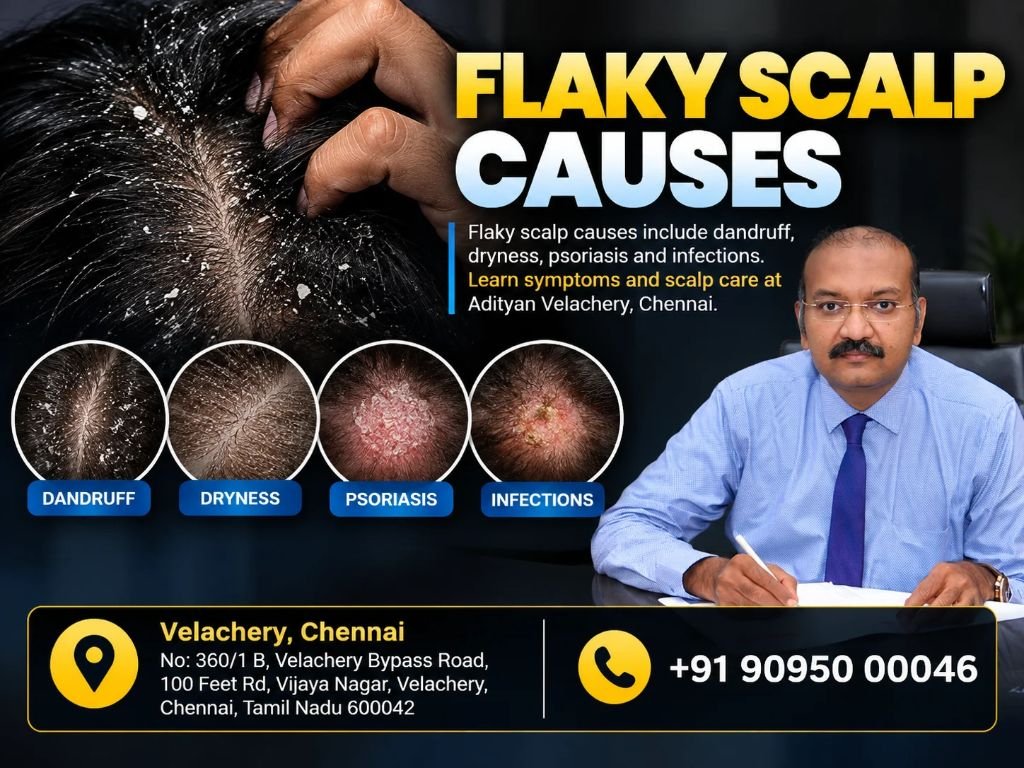
Flaky scalp causes can range from simple dryness and dandruff to skin conditions such as seborrheic dermatitis, psoriasis, eczema and fungal infections. If you frequently notice white flakes on your shoulders, itching between hair washes or patches of scaling on your scalp, understanding the underlying reason is important. At Adityan Hair and Skin Care Clinic in Velachery, Chennai, recurring scalp concerns can be assessed according to the type of flakes, scalp condition, itching and associated hair changes. Identifying the cause helps determine which scalp-care approach may be appropriate.
Many people assume that every flaky scalp is caused by dandruff. However, flakes can develop for several reasons, and the treatment that works for one condition may not help another. Understanding the differences can prevent unnecessary irritation and repeated use of unsuitable products.
What Are the Most Common Flaky Scalp Causes?
A flaky scalp develops when skin cells become visible as scales or flakes. Normally, the scalp continuously renews its outer skin layer. However, dryness, inflammation, excess oil or certain skin conditions can make shedding more noticeable.
The appearance of the flakes provides useful clues. Fine, dry flakes may occur with dryness, while greasy, yellowish scales can be associated with seborrheic dermatitis. Thick, well-defined patches may suggest psoriasis. Nevertheless, appearance alone cannot always confirm the diagnosis.
Common reasons for scalp flaking include dandruff, dry skin, scalp psoriasis, eczema, fungal infections, product buildup and excess oil. The right approach depends on the underlying condition rather than the presence of flakes alone.
7 Flaky Scalp Causes You Should Know
1. Dandruff and Seborrheic Dermatitis
Dandruff is one of the most common reasons for recurring scalp flakes. It often causes white or yellowish flakes accompanied by mild or moderate itching.
Seborrheic dermatitis is a related inflammatory condition that can produce more noticeable scaling, greasy patches and irritation. It commonly affects areas containing more oil-producing glands.
A yeast called Malassezia, which naturally lives on the scalp, is associated with dandruff and seborrheic dermatitis. The condition involves interactions between scalp oil, microorganisms and individual skin sensitivity.
Symptoms may improve with appropriate treatment but can return because seborrheic dermatitis often follows a recurring pattern.
2. Dry Scalp and Moisture Loss
A dry scalp develops when the skin does not retain enough moisture. This may cause tightness, itching and fine flakes.
Frequent exposure to harsh shampoos, very hot water and irritating hair products can contribute to dryness. Some people also experience increased discomfort when the surrounding environment is dry.
Unlike dandruff associated with oily skin, simple scalp dryness may occur without greasy patches or significant inflammation.
Gentle cleansing and avoiding irritating products can help support the scalp's protective barrier. However, persistent flaking should not automatically be treated as dryness because other conditions can produce similar symptoms.
3. Scalp Psoriasis
Psoriasis is a long-term inflammatory condition that causes skin cells to accumulate more rapidly than usual.
Scalp psoriasis may produce thick, well-defined patches covered with white, silvery or grey scales. These patches can sometimes extend beyond the hairline onto the forehead, behind the ears or the back of the neck.
On Indian skin tones, inflammation may appear dark brown, purple or grey rather than bright red.
Psoriasis can also cause itching, burning or soreness. Scratching thick plaques may lead to cracking or bleeding.
4. Scalp Eczema and Product Sensitivity
Eczema can cause dry, itchy and inflamed skin, including on the scalp. The affected areas may feel rough or irritated, particularly during flare-ups.
Contact dermatitis is another possible cause. It can develop when the scalp reacts to ingredients in hair dyes, shampoos, fragrances or styling products.
Someone may notice increased itching, irritation or scaling after introducing a new product.
Identifying the responsible irritant or allergen is important because repeatedly using the same product may prolong the reaction.
5. Fungal Scalp Infection
Fungal infections such as tinea capitis can produce scaling, itching and patches of hair loss.
Unlike ordinary dandruff, some fungal scalp infections may cause broken hairs, bald patches or inflamed areas.
These infections require a different treatment approach from routine dandruff. Antifungal shampoo alone is generally insufficient to treat tinea capitis, which usually requires prescribed oral antifungal medication.
This distinction is particularly important when scalp flakes occur together with patchy hair loss.
6. Hair Product Buildup
Frequent use of styling creams, dry shampoos, gels and sprays can leave residue on the scalp.
Product buildup may resemble flakes, especially when dried styling products mix with natural oil and dead skin cells.
Heavy buildup can also make the scalp feel greasy or uncomfortable. However, residue is not always the cause of itching or scaling.
A suitable cleansing routine may reduce product accumulation, while persistent inflammation suggests that another scalp condition could be present.
7. Excess Oil and Scalp Irritation
Sebaceous glands naturally produce oil to protect the scalp and hair.
Some people produce more oil than others. When the scalp becomes greasy, dead skin cells and flakes may stick together, making scaling more noticeable.
Excess oil alone does not necessarily cause dandruff, but an oily scalp can be associated with seborrheic dermatitis.
In Chennai's warm and humid conditions, sweating may increase scalp discomfort. However, sweat, excess oil and dandruff are different issues and should not automatically be treated as the same condition.
Scalp Conditions: Symptoms and Differences
| Scalp Condition | Common Symptoms | Typical Appearance | Important Clue |
|---|---|---|---|
| Dandruff | Flaking and itching | White or yellowish flakes | Often recurring |
| Dry scalp | Tightness, dryness and itching | Fine, dry flakes | Usually less greasy |
| Seborrheic dermatitis | Itching and inflammation | Greasy scales and irritated patches | Often affects oily areas |
| Scalp psoriasis | Scaling, itching or soreness | Thick, defined plaques | May extend beyond the hairline |
| Scalp eczema | Itching and irritation | Dry or inflamed patches | May worsen after exposure to triggers |
| Fungal infection | Scaling and possible hair loss | Scaly patches with broken hairs | May cause patchy hair loss |
| Product buildup | Residue and scalp discomfort | Flaky-looking product deposits | May follow heavy product use |
This table provides a general comparison rather than a diagnostic test. Different scalp conditions can overlap, making proper identification important when symptoms continue.
How to Identify and Manage a Flaky Scalp
Can a Flaky Scalp Cause Hair Fall?
A flaky scalp does not always cause hair loss. Simple dandruff generally does not lead to permanent hair loss.
However, persistent itching and inflammation can encourage repeated scratching. Aggressive scratching may damage hair shafts and contribute to breakage.
Certain underlying conditions, including fungal infections and inflammatory scalp disorders, can also affect hair growth.
If flaking occurs together with noticeable thinning, broken hairs or bald patches, the scalp and hair-loss pattern should be assessed together rather than assuming dandruff is the only problem.
How to Manage a Flaky Scalp Safely
A suitable scalp-care routine depends on the underlying condition.
Regular cleansing can help remove excess oil, dead skin cells and styling-product residue. However, using very harsh shampoos or scratching aggressively during washing may worsen irritation.
For dandruff, medicated shampoos containing ingredients such as ketoconazole, selenium sulfide or salicylic acid may be appropriate, depending on the condition. Some products need to remain on the scalp for several minutes before rinsing, so the specific instructions matter.
Dryness-related flaking may benefit from gentler cleansing and avoiding irritating products.
Psoriasis, eczema and fungal infections may require different treatments. Using the same shampoo for every type of scalp scaling is therefore not always effective.
Why Does My Scalp Keep Flaking After Shampooing?
Persistent flaking after shampooing can occur for several reasons.
The shampoo may not address the underlying condition, or the scalp may be experiencing ongoing inflammation. Some people may also react to particular ingredients in their hair-care products.
Dandruff and seborrheic dermatitis can recur even after symptoms temporarily improve.
Repeatedly changing shampoos without identifying the problem may therefore provide inconsistent results. Understanding whether the flakes are caused by dryness, dandruff, psoriasis or another condition is more useful than focusing only on washing frequency.
When Should Persistent Scalp Flaking Be Examined?
Occasional mild flakes are common. However, persistent scaling deserves closer attention when it is accompanied by severe itching, pain, inflammation, crusting or visible hair loss.
Thick plaques, broken hairs, bald patches, discharge or symptoms that do not improve with appropriate dandruff care may suggest another scalp condition.
A scalp examination can help distinguish common dandruff from other causes and guide suitable management.
Flaky Scalp Care at Adityan Velachery
At Adityan Hair and Skin Care Clinic in Velachery, Chennai, recurring scalp concerns can be evaluated according to the appearance of flakes, scalp oiliness, itching, inflammation, duration of symptoms and associated hair changes.
The assessment may help distinguish dandruff, seborrheic dermatitis, scalp psoriasis, eczema and other conditions that produce similar symptoms.
Understanding the underlying cause is important because different scalp problems may require different treatment approaches. You can also learn about dermatology and the medical assessment of skin, hair and scalp conditions.
Frequently Asked Questions
1. What is the most common cause of a flaky scalp?
Dandruff is one of the most common causes. However, dryness, seborrheic dermatitis, psoriasis, eczema and fungal infections can also produce visible flakes. The appearance and associated symptoms help distinguish possible causes.
2. Can a flaky scalp happen without dandruff?
Yes. Dry skin, psoriasis, eczema, contact dermatitis and some scalp infections can cause flaking without ordinary dandruff. Not every white flake indicates the same condition.
3. Does washing hair every day prevent scalp flakes?
Not necessarily. Some people with oily scalps benefit from frequent cleansing, while others may experience irritation from excessive washing or harsh products. The ideal routine depends on scalp condition and hair type.
4. Can stress make scalp flaking worse?
Stress may contribute to flare-ups of certain inflammatory scalp conditions, including seborrheic dermatitis and psoriasis. However, stress is not the only cause, and persistent symptoms should not automatically be attributed to it.
5. Can scalp fungus look like dandruff?
Yes. Certain fungal infections can produce scaling that resembles dandruff. Broken hairs, patchy hair loss or inflamed areas may provide additional clues. Fungal scalp infections generally require condition-specific treatment.
6. Can a flaky scalp be treated permanently?
The outcome depends on the underlying cause. Some problems, such as irritation from a particular product, may resolve after the trigger is removed. Chronic conditions such as seborrheic dermatitis and psoriasis may recur and require ongoing management.
Visit Adityan Hair and Skin Care Clinic – Velachery
If you are experiencing recurring scalp flakes, itching, scaling, scalp irritation or associated hair fall, visit Adityan Hair and Skin Care Clinic for scalp assessment.
Adityan Hair and Skin Care Clinic
No: 360/1 B, Velachery Bypass Road,
100 Feet Road, Vijaya Nagar,
Velachery, Chennai, Tamil Nadu 600042
Phone: +91 90950 00046
Visit Adityan Velachery WebsiteFinal Thoughts
Understanding flaky scalp causes is important because dandruff is only one possible explanation for recurring flakes. Dryness, excess oil, psoriasis, eczema, fungal infections and product reactions can produce similar symptoms but may require different care.
Recognising changes in flake appearance, itching, inflammation and hair density can help identify when routine scalp care may not be enough. The right approach begins with understanding the actual scalp condition rather than repeatedly trying different products without knowing the cause.